

Two carousels for two challenges
When a hospital pharmacy department considers automating its storeroom, the first question is usually what it’s short of: space or time.
- If the storeroom has outgrown its floor space and there’s no more to be had, the vertical carousel makes use of the room’s height.
- If nursing unit orders are what’s piling up, the horizontal carousel brings medication to the workstation and lets you pick several orders at once.
Vertical carousel: when floor space is limited
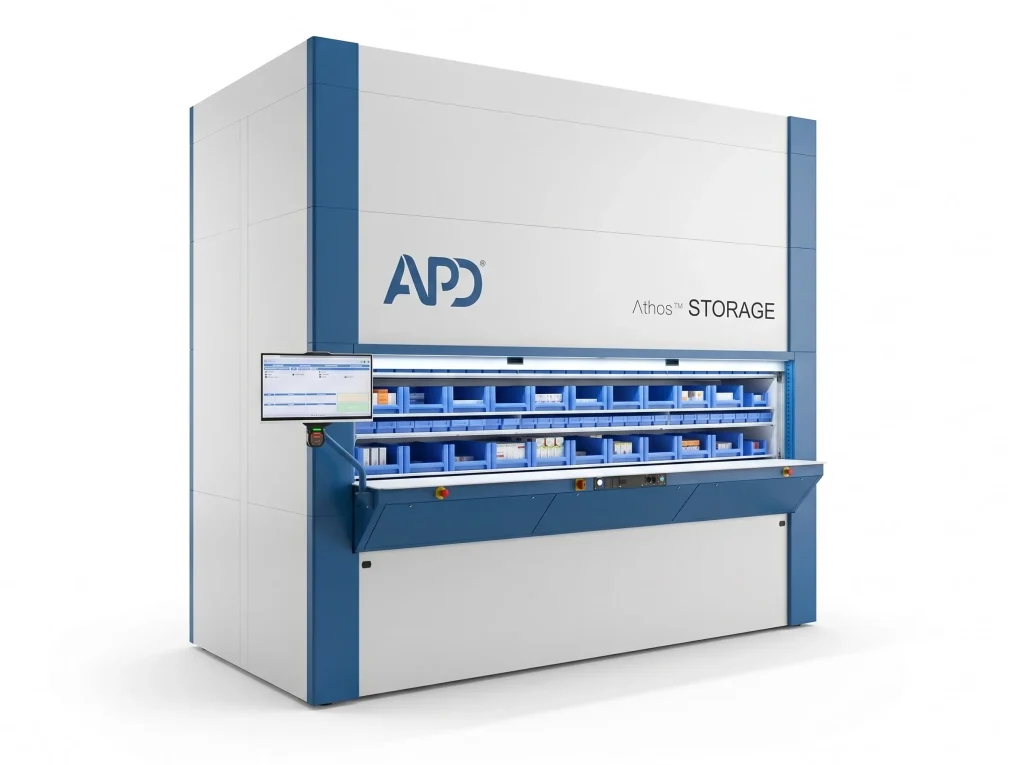
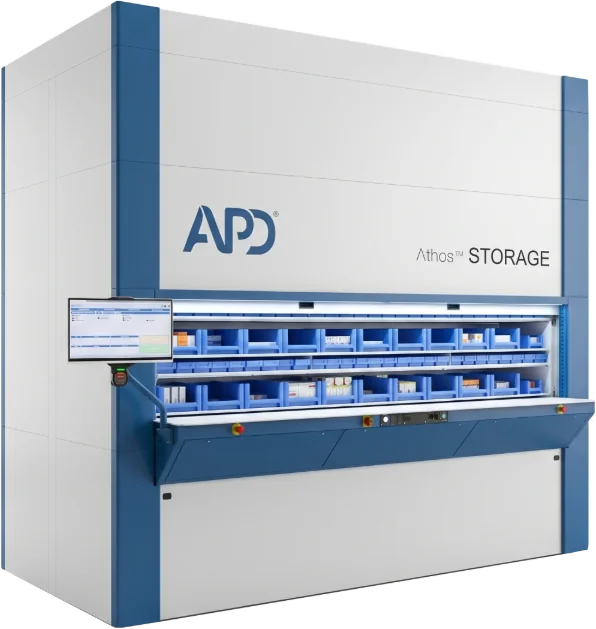
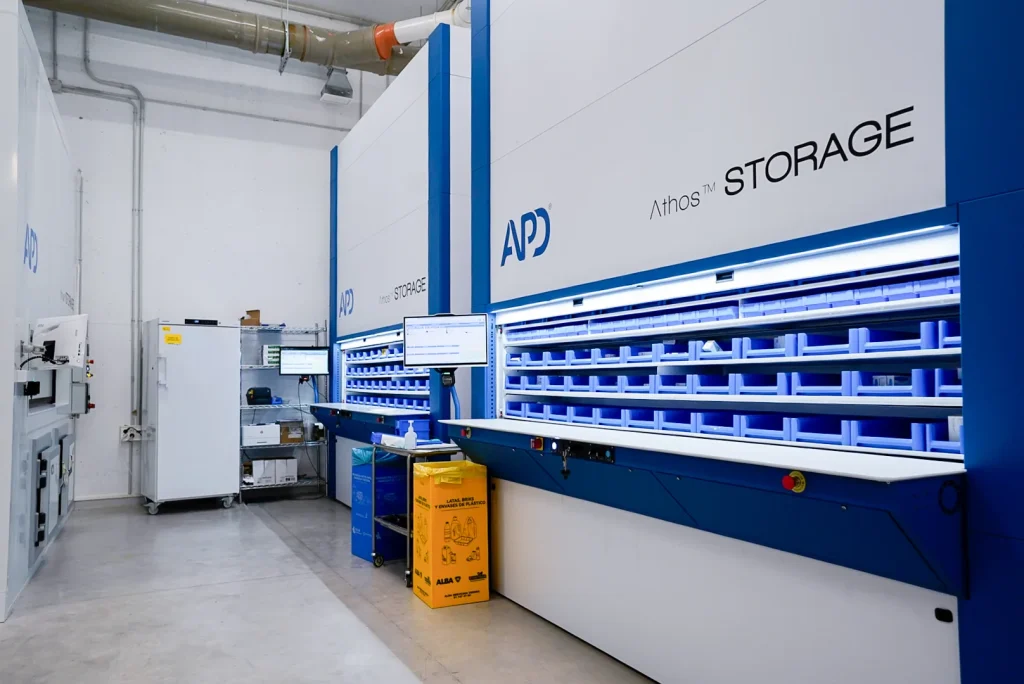
The vertical carousel stores medication on trays that rotate inside a column 3 to 6 meters tall. The tray you need comes down to the work window, at waist height, and an LED light bar marks the exact slot to pick from. The rest of the room’s height becomes storage.
As a result, the rotating trays can double the capacity of a conventional drawer in the same footprint. It also:
- Places high-turnover products where they’re quickest to reach.
- Tracks expiration dates to prevent waste.
- Comes in refrigerated and non-refrigerated versions, with the same screen and light guidance.
It suits departments with little free floor space and high ceilings, in hospitals of any size.
Horizontal carousel: when there are lots of orders
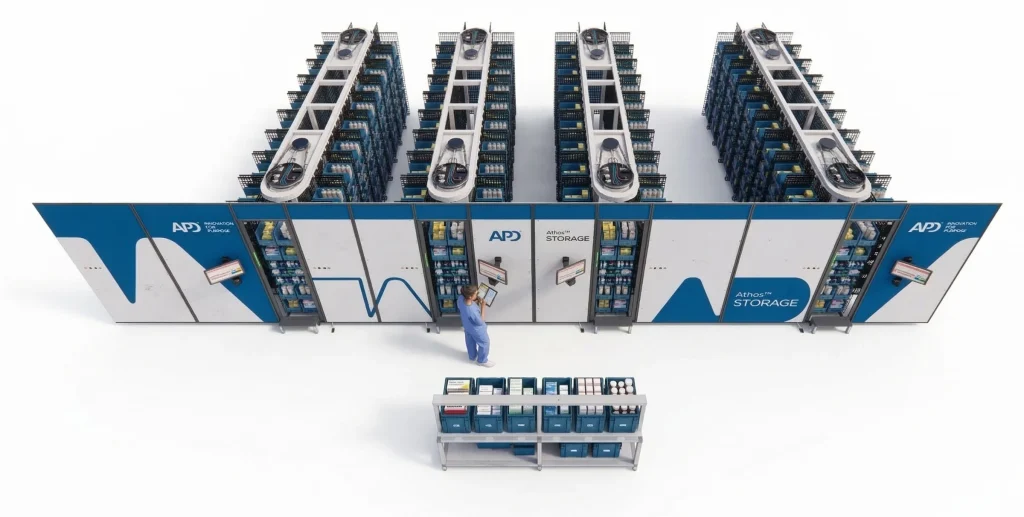
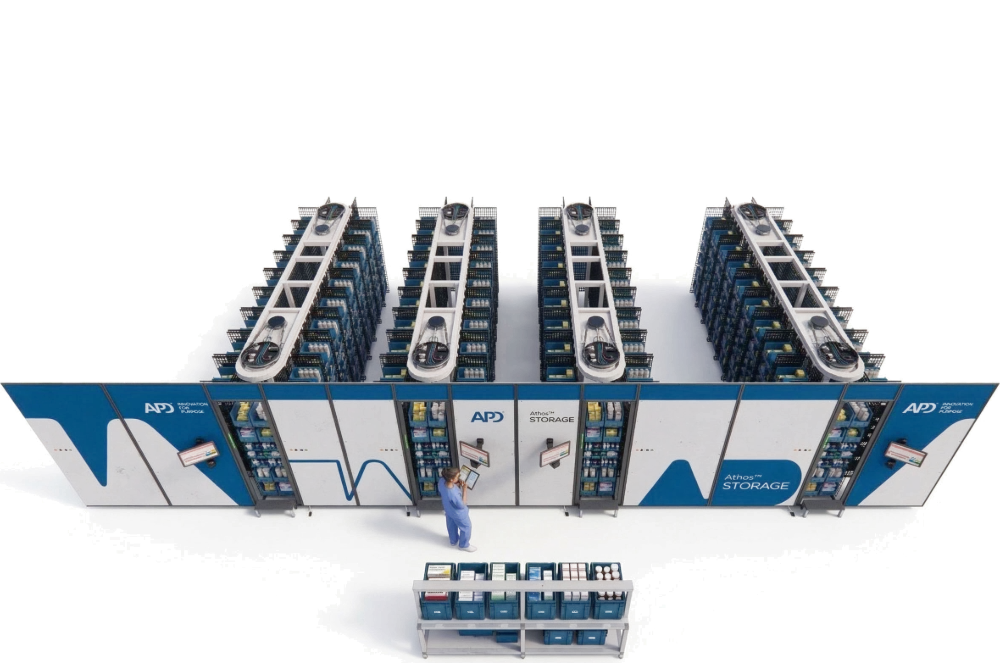
The horizontal carousel stores medication in baskets that rotate horizontally to the picking station. Medication comes to the staff member, not the other way around: no one walks the aisles.
Its strength is order picking. You release several nursing unit orders at once, the screen shows which medication to pick and how many units in total, and the sorting table uses lights to show how many to place in each bin, one bin per order. That’s how it reaches 350 to 600 lines per operator per hour, compared with around 60 in a conventional system where the operator goes to the product.
It suits departments that prepare many orders a day for nursing units, the ICU and the emergency department, usually in large hospitals. It also comes in a refrigerated version.
Vertical and horizontal carousels side by side
| Vertical carousel | Horizontal carousel | |
|---|---|---|
| What it solves | Lack of floor space | Order volume |
| What it uses | The room’s height (3 to 6 m) | Floor space |
| How it stores medication | Trays that rotate vertically | Baskets that rotate horizontally |
| How you work | Waist-height window, touchscreen and LED light at the slot | Picking station with a screen, and sorting table with a light for each order |
| Biggest benefit | Up to twice the capacity in the same footprint | 350 to 600 lines per operator per hour |
| Refrigerated medication | Refrigerated and non-refrigerated versions | Refrigerated and non-refrigerated versions |
| Integration | With the hospital pharmacy management application | With the hospital pharmacy management application |
Which one does your hospital pharmacy need?
Four questions to point you in the right direction:
- Are you short of space or short of time? If the storeroom can’t hold any more, start with the vertical. If orders are what’s piling up, start with the horizontal.
- How tall is the room? Vertical carousels are configured from 3 to 6 meters tall: the more clear height you have, the more capacity you gain.
- How many orders do you prepare a day? With many nursing unit orders every day, the horizontal saves the most time.
- Do you have refrigerated medication to automate? Both carousels come in a refrigerated version, so you can include it in whichever one fits your space best.
Hospital size matters too. According to the national survey by the Spanish Society of Hospital Pharmacy (SEFH) (in Spanish), departments in hospitals with 1,000 beds or more have an average of 4.3 vertical carousels and around one horizontal.
Or both: vertical and horizontal carousels working together
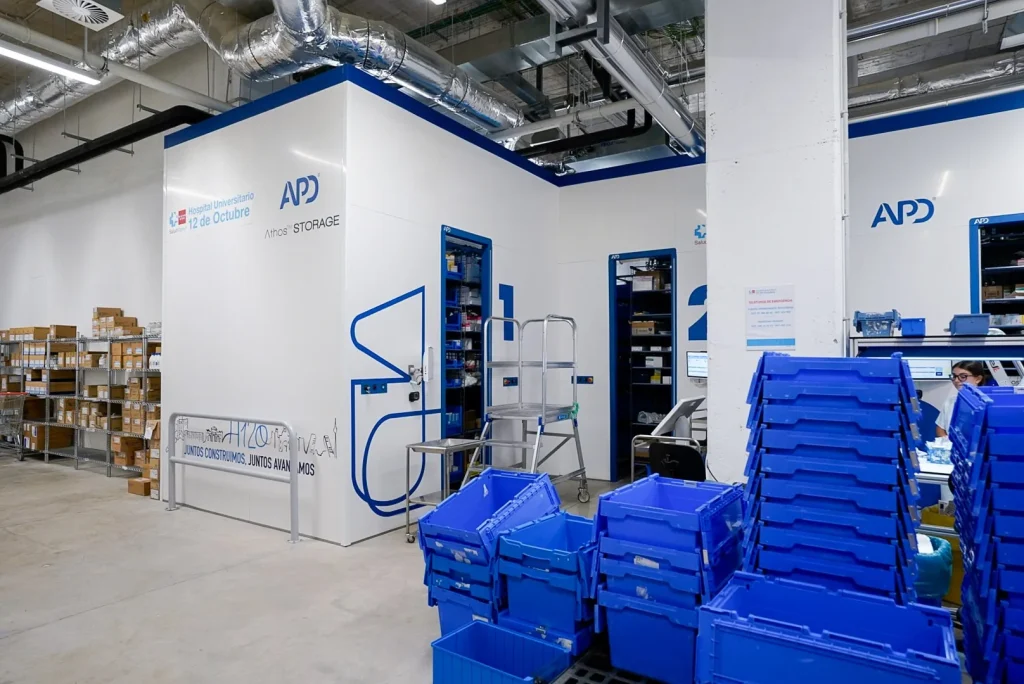
It doesn’t have to be one or the other. If the storeroom has room for both, they share the work. For example, the horizontal can handle nursing unit orders while the vertical stores the rest of the items in a small footprint. Both connect to the hospital pharmacy management application, so orders and inventory stay in the same system.
How far you can combine them depends on the size of the storeroom and the workload. That’s why we define the number of carousels, trays and baskets for each project.
That’s what Hospital Universitario 12 de Octubre in Madrid does. It has worked with Athos™ systems since 2016, and its hospital pharmacy department has four horizontal carousel lines plus two refrigerated ones, as well as three vertical carousels, one of them refrigerated.
Want to see them in action? You can visit them at Hospital Universitario 12 de Octubre: get in touch and we’ll arrange the visit. We’ll analyze your storeroom and propose the combination that fits your space and your order volume.
FAQ
What’s the difference between a vertical and a horizontal carousel?
The vertical uses the room’s height and gains capacity when floor space is tight. The horizontal uses floor space and is designed to pick many orders at once from a fixed station. Both guide every pick with a screen and light.
Which one suits a small hospital?
It depends more on space and orders than on the number of beds. In small and medium-sized hospitals the vertical is the most common, according to the SEFH national survey, because it solves the lack of floor space without needing a high order volume.
Can a carousel store refrigerated medication?
Yes. Both the vertical and the horizontal carousel come in a refrigerated version, with the same screen and light guidance as the standard one.
Can both be installed in the same storeroom?
Yes, if there’s room. Both work with the hospital pharmacy management application, so orders and inventory stay in a single system. Hospital Universitario 12 de Octubre combines six horizontal carousel lines, two of them refrigerated, with three vertical carousels, one of them refrigerated.
Do they integrate with the hospital pharmacy software?
Yes. They receive orders from the hospital pharmacy management application and update the inventory with every pick.
Solutions in this article