What the hospital pharmacy will look like in 2027
2027 is just around the corner, and the direction is already set. Hospital pharmacists and European regulation point the same way.
Less logistics, more time for patients
In June 2025 the Spanish Society of Hospital Pharmacy (SEFH) published Proyecto SEFH 2030, 20 challenges for hospital pharmacy departments (in Spanish). Its standards include cutting the logistical and administrative workload of pharmacy departments and digitalizing every department process to reduce medication incidents. Among the resources to get there, it names robotic medication storage and dispensing systems.
Assisted prescribing and connected systems
Challenge 9 of the same project, on the digital transformation of hospital pharmacy, asks each department to build a digital transformation strategy into its strategic plan and to roll out AI-assisted electronic prescribing. To get the most out of it, cabinets, carousels and carts need to be connected to that prescribing system and to the hospital pharmacy management software.
Medication data shared across Europe
The European Health Data Space (Regulation (EU) 2025/327) has been in force since March 2025, and its obligations on electronic prescribing and dispensing start to apply in March 2029. Spain starts ahead, since it already has interoperable e-prescriptions.
Everything points to a hospital pharmacy with fewer manual tasks and every dose located and recorded, from storeroom to patient. The good news is you don’t have to wait: the systems for each phase of the cycle already exist.
What hospital pharmacy automation is
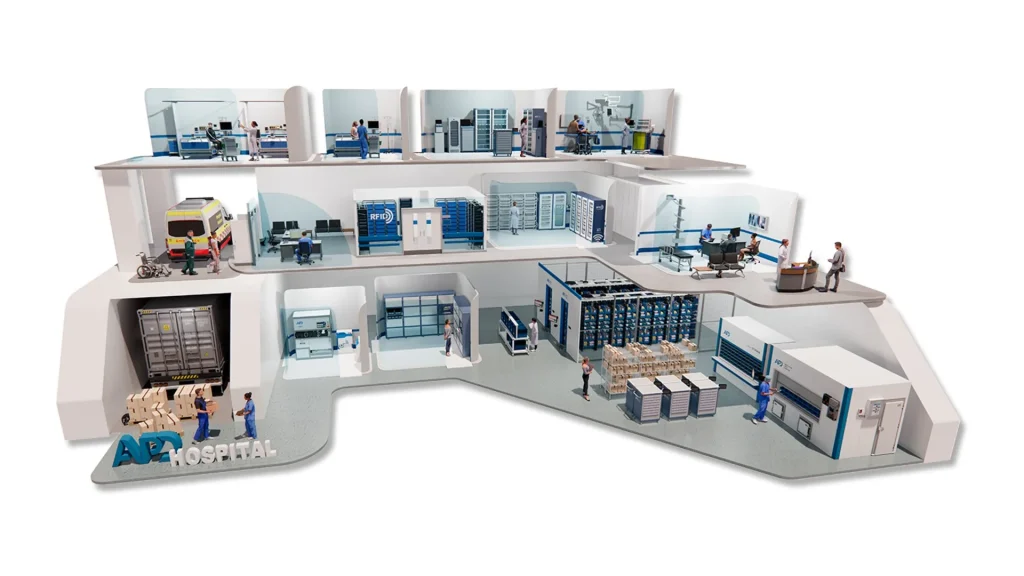
Hospital pharmacy automation connects every step a medication takes inside the hospital, from the moment it enters the storeroom to the moment it’s given at the bedside. Every dose is located and recorded at all times, so it reaches the patient safely.
A medication changes hands many times before it reaches the patient. It arrives at the hospital pharmacy storeroom, gets repackaged as a unit dose, goes up to the nursing unit and someone administers it. Every manual handoff leaves room for error: the wrong product, stock nobody has counted, a dose past its expiry date.
Automation replaces those handoffs with systems that identify every unit and record every movement. Clinical decisions stay with the staff. The equipment handles locating and recording.
What the hospital gains is medication traceability. If a system knows where every dose is, it can warn before a stockout, block a removal that doesn’t match and prove afterwards what each patient received. That’s why the New Technologies Evaluation Group of the Spanish Society of Hospital Pharmacy (SEFH) set technical criteria for automated dispensing systems back in 2007, and ISMP Spain published recommendations for using them safely (both in Spanish).
The medication cycle in 4 phases
| Phase | What happens to the drug | What gets automated | Athos™ systems |
|---|---|---|---|
| 1. Storage | It enters the hospital pharmacy and is stored | Storage, order picking for nursing units, restocking of unit storerooms and custody of high-cost supplies | Vertical Storage, Horizontal Storage, Kanbanet, Dosys RFID |
| 2. Cutting & packaging | It is prepared as a unit dose | Blister cutting, repackaging and labeling of every dose | uniBOT, uniPACK |
| 3. Nursing unit | It reaches inpatient units and the operating room | Dispensing, controlled substances and cabinet restocking | Dosys, Dosys Narcotics, Dosys Anesthesia, CareGo |
| 4. Administration | It is given to the patient | Patient identification and dose verification at the bedside | Mobit |
You don’t have to automate everything at once. Each phase works on its own and connects to the others through the hospital pharmacy management software.
Phase 1. Storage: stock located from day one
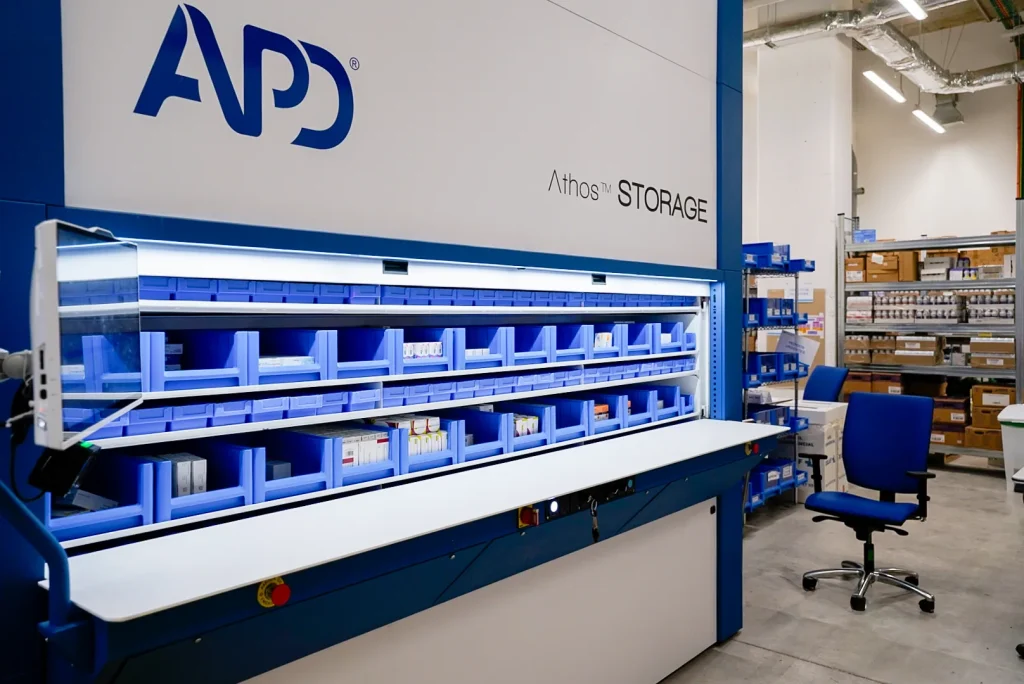
In a conventional storeroom, the operator goes to the product: walks the aisles, finds the item and writes it down. Carousels flip that around. The product comes to the workstation, and a screen and a light show what to pick.
Vertical or horizontal carousel
The choice depends mostly on the room.
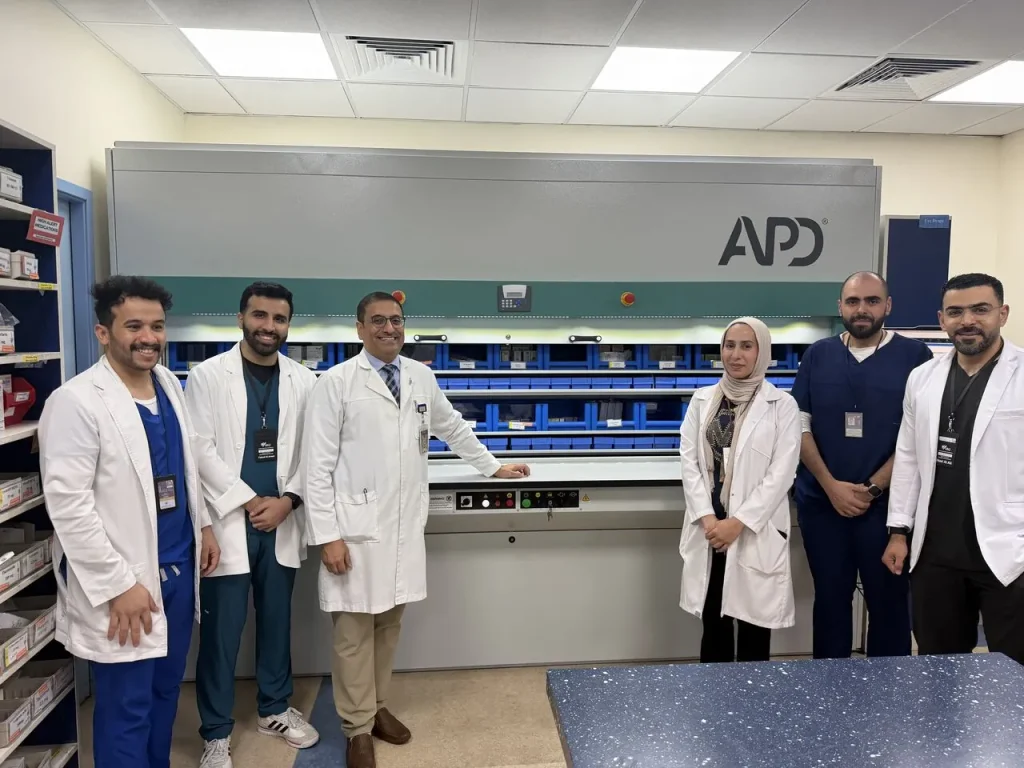
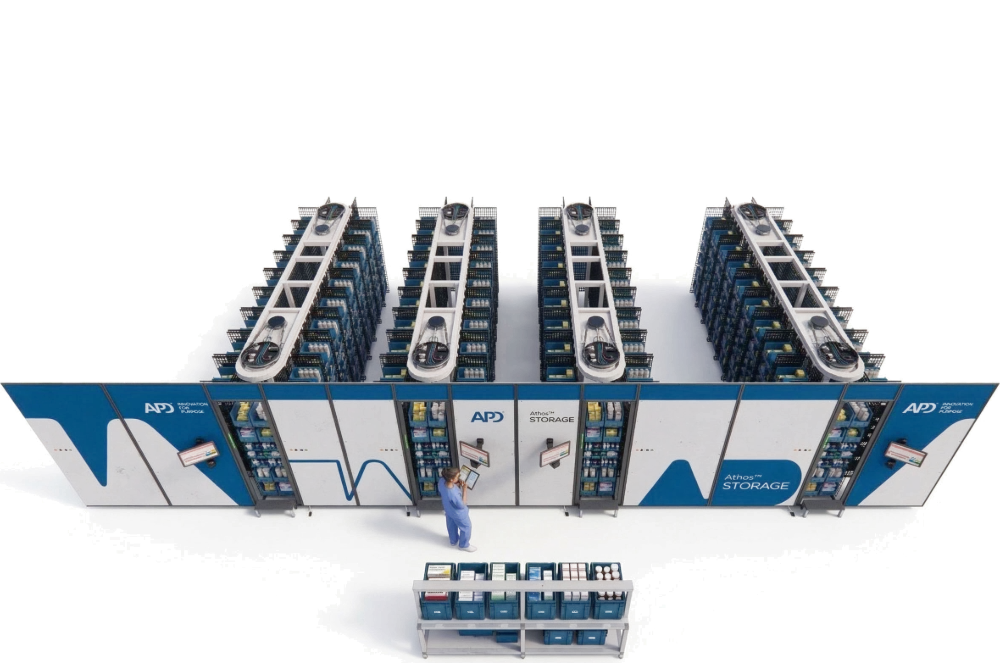
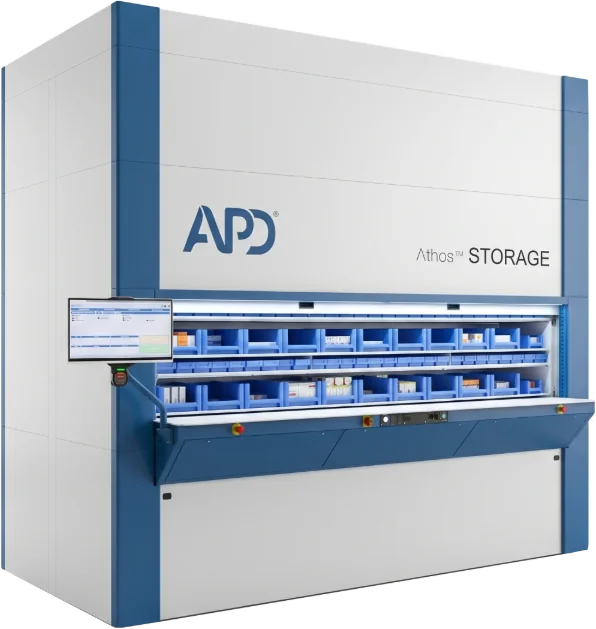
- The Athos™ Vertical Storage carousel uses the room’s height when floor space is short. It goes from 3 to 6 meters, can double the capacity of a conventional drawer in the same footprint and comes in a refrigerated version.
- The Athos™ Horizontal Storage carousel uses the storeroom floor and is built to fill many orders from one fixed station: 350 to 600 lines per operator per hour, compared with about 60 in a conventional setup.
Both connect to the hospital pharmacy management software. Inventory updates with every pick and expiry dates stay visible.
Two-bin kanban for unit storerooms
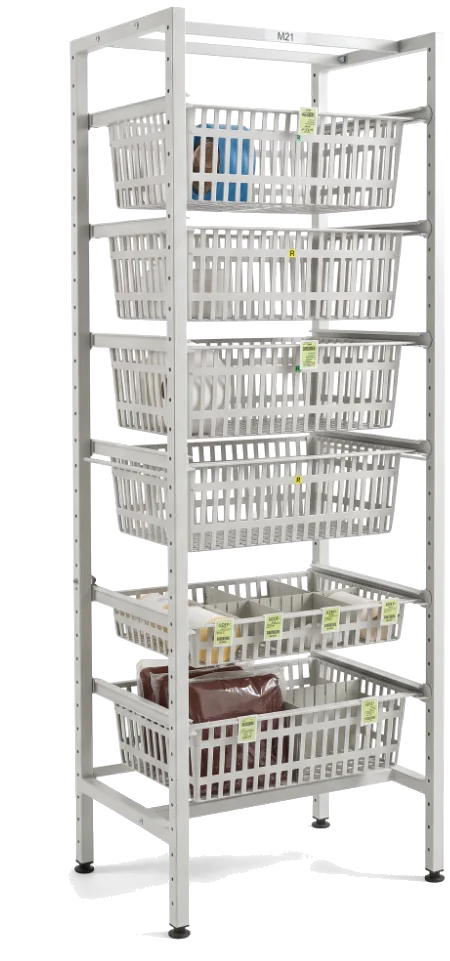
Supplies in each unit’s storeroom can be restocked without paper order forms too. With the Athos™ Kanbanet two-bin kanban system, each item has an in-use bin and a reserve bin. When the in-use bin empties, nursing drops its tag into an RFID reader box and the restocking order is created automatically. Logistics sees what each unit needs in real time, and the unit keeps working from the reserve until the order arrives.
High-cost medical supplies
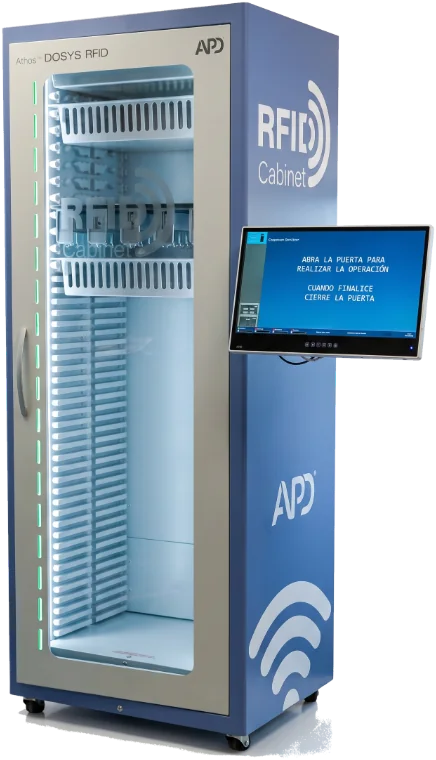
With prostheses, implants and specialized devices, knowing how many are left isn’t enough: you have to be able to prove which patient and which procedure each unit was used for. The Athos™ Dosys RFID cabinet reads every tag at once when the door closes and links each removal to the patient.
Phase 2. Cutting & packaging: every unit dose identified
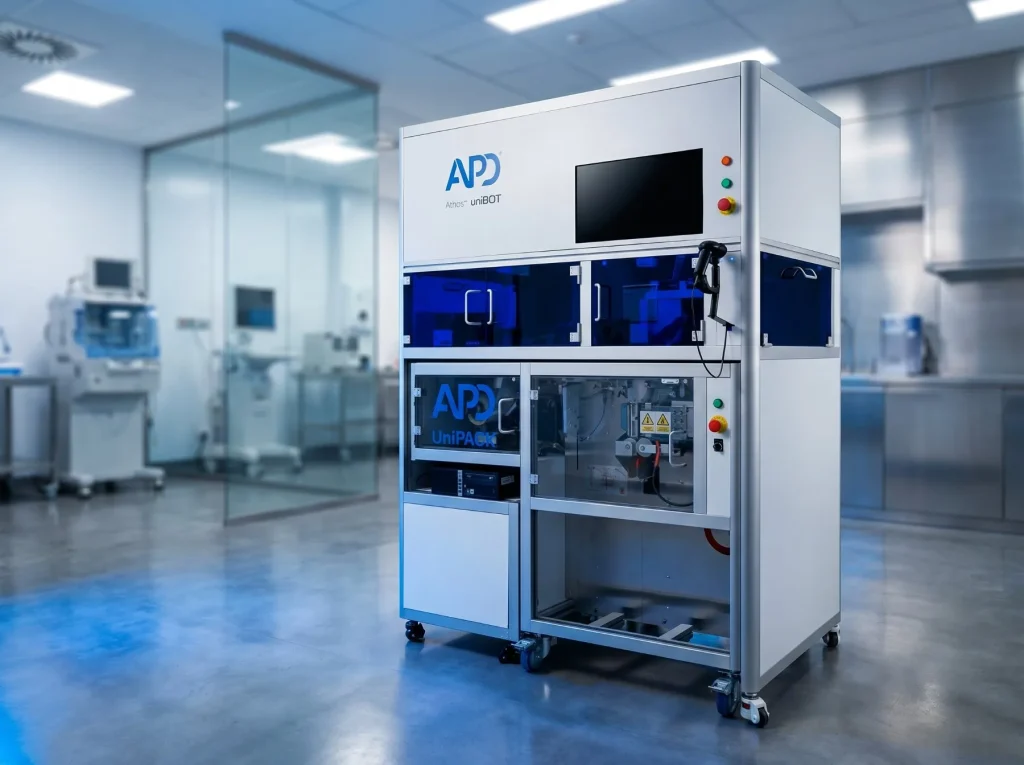
Unit dose distribution means every dose has to be separated and labeled. Done by hand, it’s one of the most labor-intensive tasks in the hospital pharmacy. And when the process isn’t documented, it’s a common source of identification errors.
Two machines work in this phase:
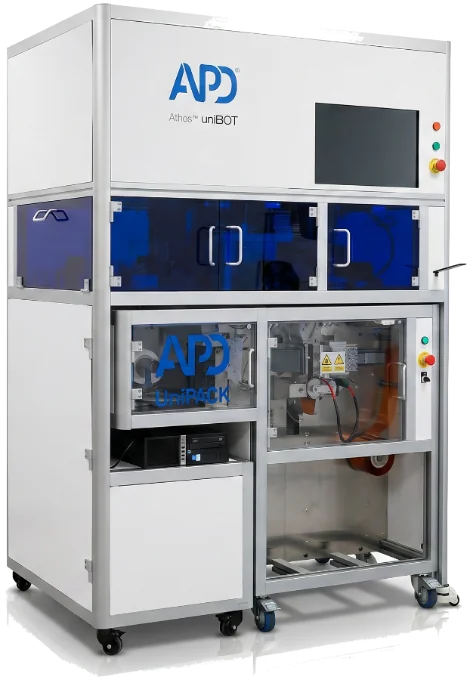
- Athos™ uniBOT robotically cuts blisters, ampoules and vials and repackages each dose in its own pouch. It handles the five common blister formats and has uniPACK built in.
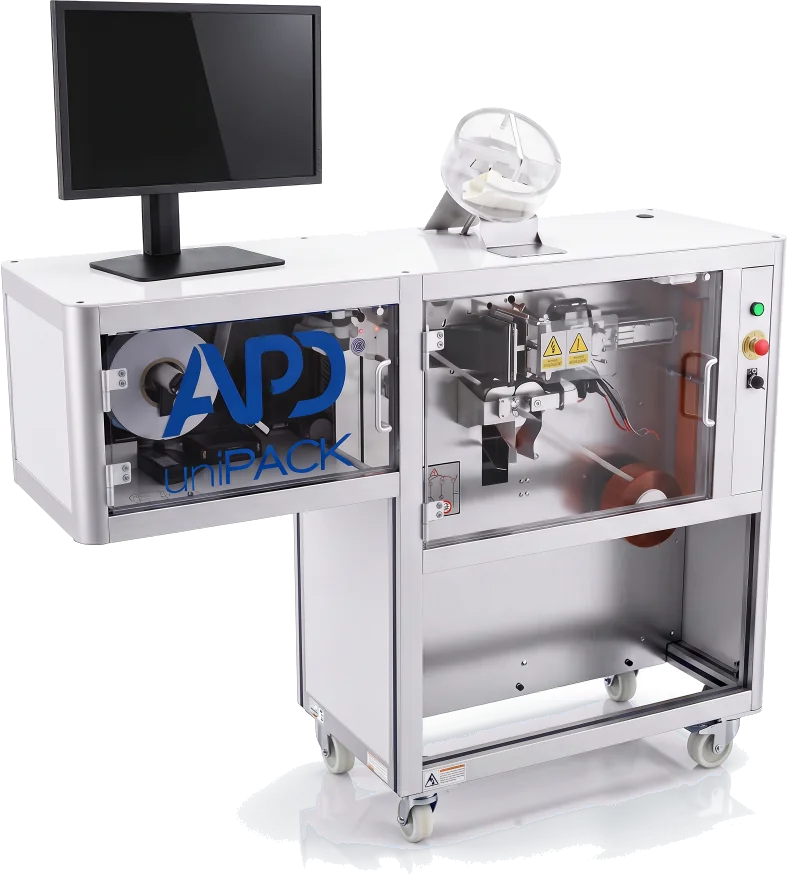
- Athos™ uniPACK is the unit dose packaging machine. It heat-seals oral solids and, with its automatic hopper, also bulk medication, ampoules and vials.
Each pouch comes out with the medication details printed on it (dose, lot, expiry date, 1D and 2D codes) and a unique code. From then on the dose can be recognized anywhere in the cycle, without its original packaging, and traced to the patient.
Phase 3. Nursing unit: dispensing with automated dispensing cabinets
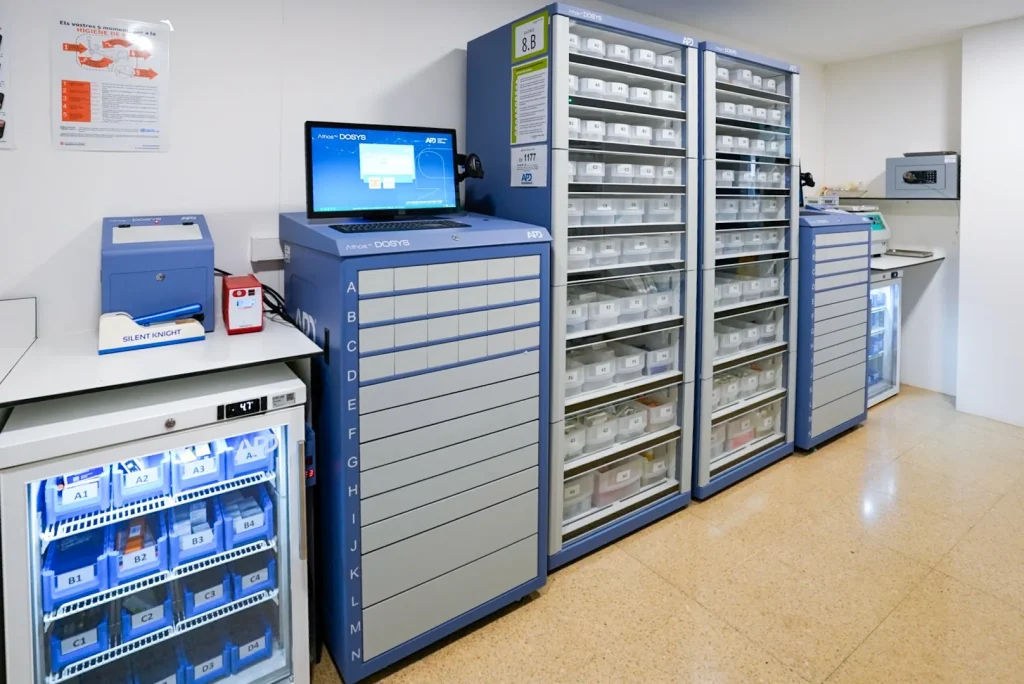
On many nursing units, medication still sits in ward stock that nurses restock and count by hand. Automated dispensing cabinets (ADCs) replace it with cabinets connected to the hospital pharmacy system.
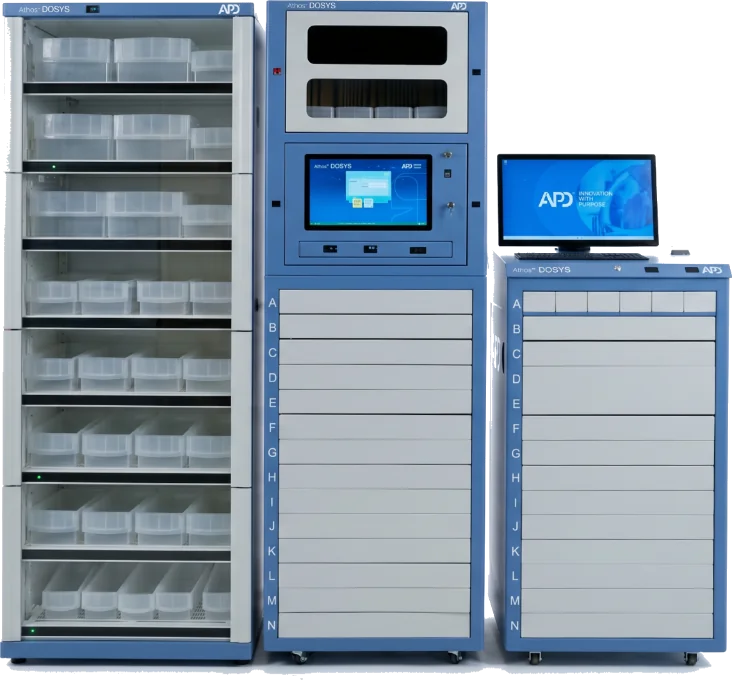
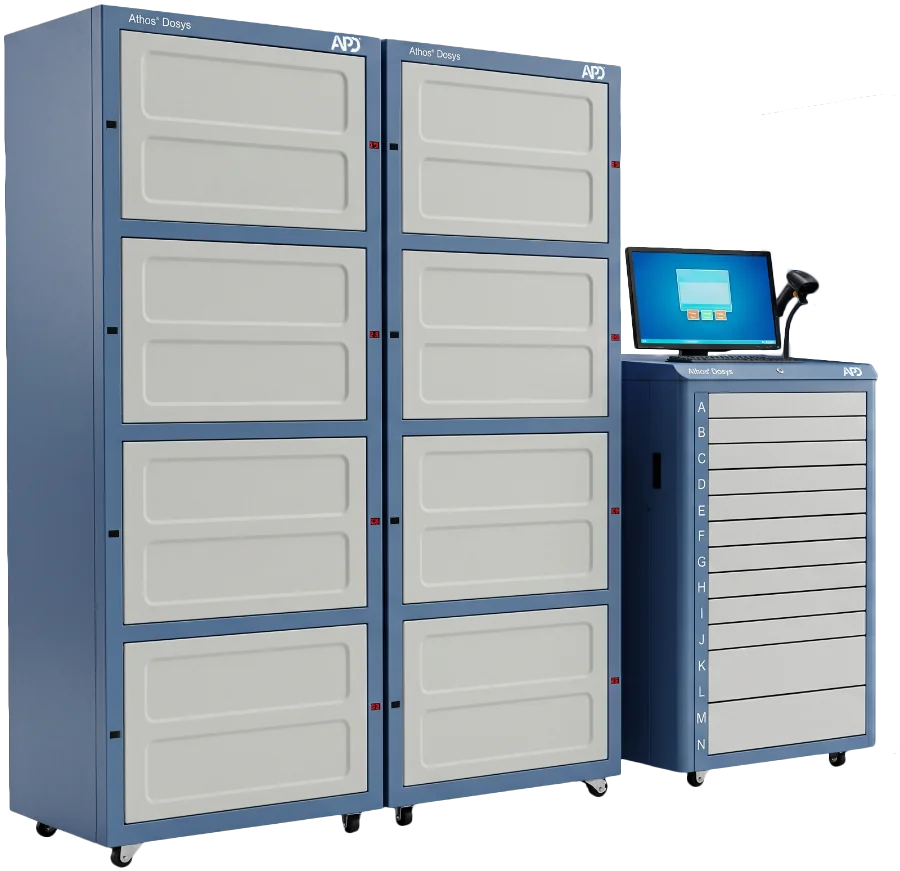
With Athos™ Dosys, every drawer opening is recorded and every unit comes off inventory instantly. The system warns before a product expires and integrates with electronic prescribing over HL7. Hospitals that use it report 20% to 40% lower net medication costs, thanks to less waste and fewer expired products.
A Dosys system is built from connected pieces. The base unit (Athos™ Dosys Base) identifies each user and controls the whole system. Around it you add auxiliary cabinets for more capacity; Athos™ eLock, an electronic lock for the unit’s fridges that logs every opening; and Athos™ Dosys Bin, which collects and records medication returns on the unit. A single Base controls up to 8 columns, auxiliary cabinets and fridges.
The Dosys family has versions for areas of the hospital with their own requirements.
Controlled substances, in the pharmacy and in the OR
Controlled substances need their own cycle and a record of every movement. Athos™ Dosys Narcotics logs receipts, restocks, dispensing, compounding and write-offs, and generates the traceability report from the system itself, with no paperwork.
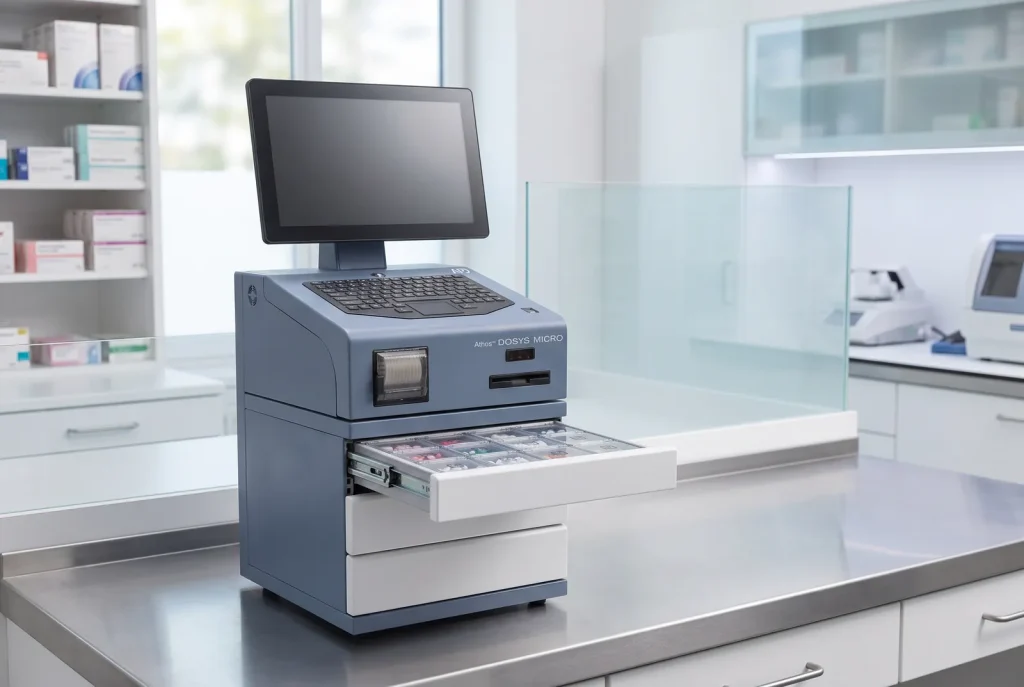
And the family just grew. Athos™ Dosys Micro is the Base in a compact countertop or wall-mounted format for units short on space: it takes up less room and keeps the same control and traceability.
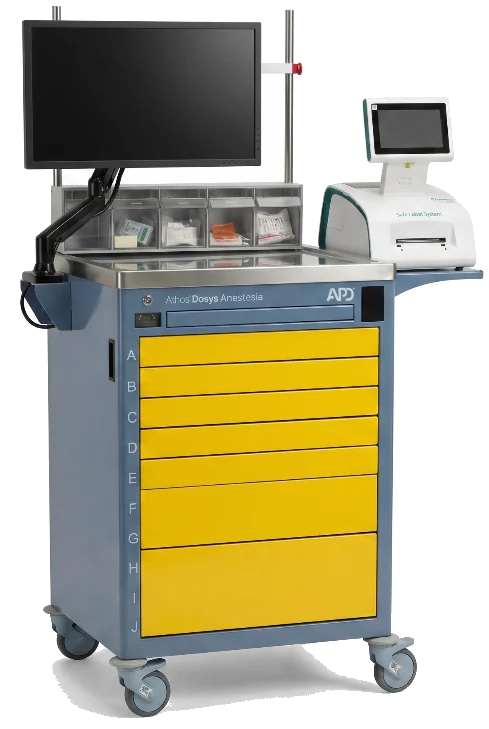
In the operating room, Athos™ Dosys Anesthesia keeps anesthesia medications under control. The anesthesiologist logs in with an RFID card, every syringe is labeled, voice verification confirms the medication and what was given goes into the electronic health record.
Cabinet restocking
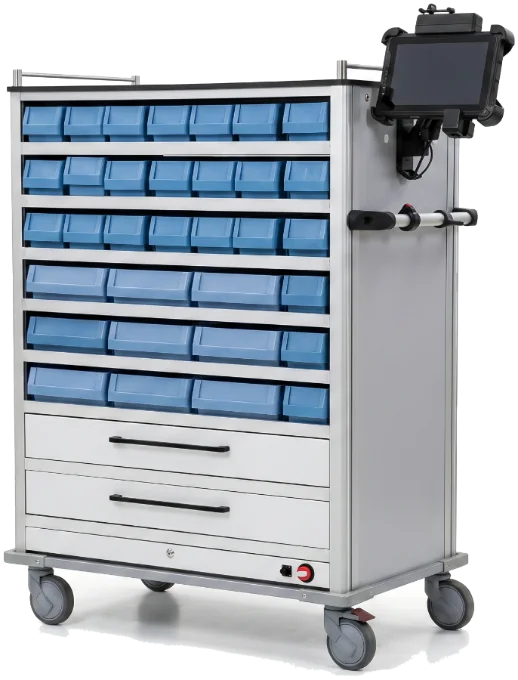
Restocking dozens of cabinets a day can be guided too. Athos™ CareGo is a guided restocking cart: it receives orders from the hospital pharmacy system, shows what to load, lights up the exact slot in the destination cabinet and verifies each restock with a scanner before closing it out.
Phase 4. Administration: the last check, at the bedside
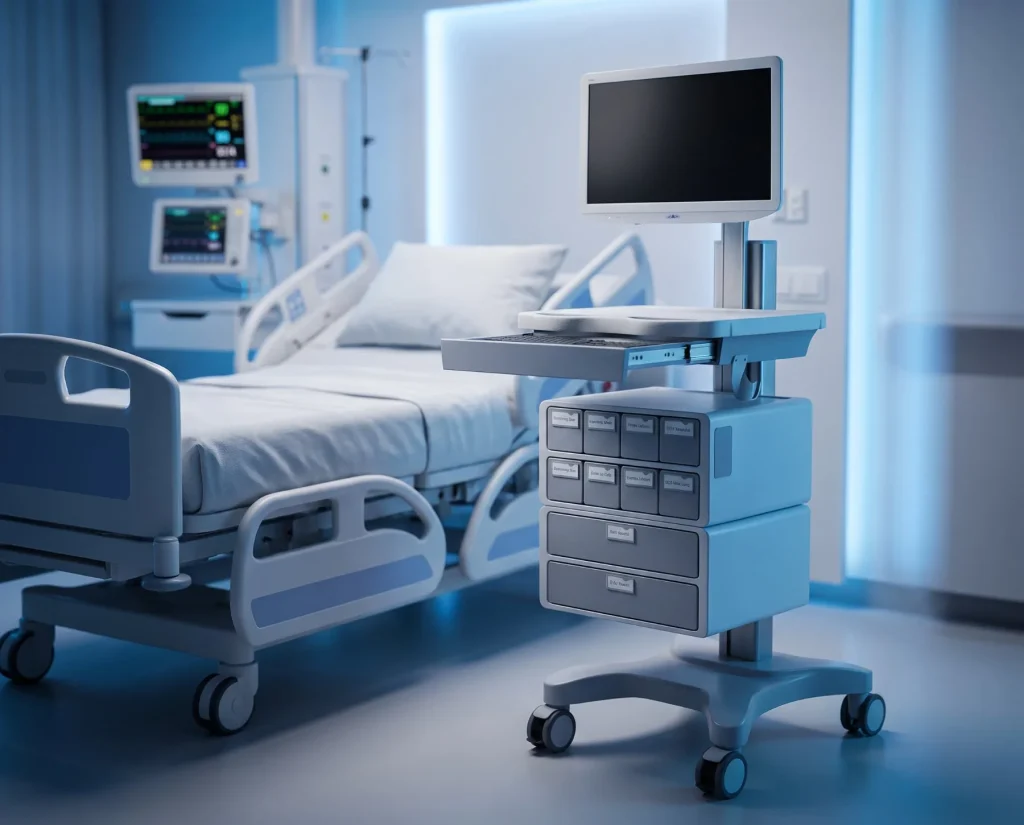
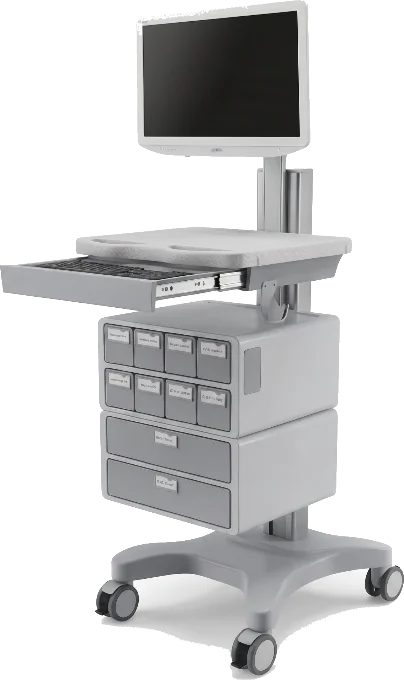
It’s the last step and the only one that happens in front of the patient. Athos™ Mobit is a bedside medication cart that receives each patient’s doses from the unit’s ADC. When the wristband is scanned, only that patient’s drawer opens and the screen shows their administration record, with real-time electronic prescribing. The nurse checks the dose before giving it.
Where to start
Few hospitals automate the whole cycle at once. Most start with the phase that creates the most manual work or the most incidents, and grow from there. Four questions help decide:
- Where is the most time lost? Counting stock on the units, repackaging by hand and filling unit orders usually take the most hours.
- Where is the most risk? Controlled substances, high-alert medications and high-cost supplies need full traceability before anything else.
- What space do you have? The height and floor area of the storeroom decide between a vertical and a horizontal carousel.
- What does it need to integrate with? Electronic prescribing, the hospital pharmacy management software and the electronic health record.
With those answers, we map how medication moves through your hospital and propose a solution you can see working in a demo with the pharmacy and nursing teams.
APD, the Spanish manufacturer behind Athos™
At APD (Algoritmos, Procesos y Diseños S.A.) we’ve been designing, building and installing systems that automate critical processes since 1980. The Athos™ family is manufactured at our plant in Leganés (Madrid), installed by our team and maintained by our technical service. Our solutions are in more than 90 hospitals in Spain, and our technology in more than 20 countries.
Not sure which phase to start with? Tell us how medication moves through your hospital.
FAQ
What is an automated dispensing cabinet (ADC)?
It’s a cabinet on an inpatient unit connected to the hospital pharmacy system. It records every removal, takes each unit off inventory instantly and tracks expiry dates. In Spain the SEFH calls them SAD, while healthcare professionals call them SADME.
What’s the difference between a vertical and a horizontal carousel?
A vertical carousel uses the room’s height (3 to 6 meters) and suits hospital pharmacies with little free floor space. A horizontal carousel uses the storeroom floor and is built to fill several orders at once from a fixed station. Both guide every pick with a screen and a light.
Why is medication repackaged as unit doses?
So every dose is identified on its own, with its medication name, strength, lot and expiry date, and can be traced to the patient without its original packaging. An automated unit dose packaging machine does that work and adds a unique code to every pouch.
How much does hospital pharmacy automation save?
It depends on the phase. On the nursing units, hospitals using Athos™ Dosys report 20% to 40% lower net medication costs. In the storeroom, a horizontal carousel fills 350 to 600 lines per operator per hour, compared with about 60 in a conventional setup.
Does it integrate with electronic prescribing and hospital systems?
Yes. Athos™ systems connect to the hospital pharmacy management software, and Athos™ Dosys integrates over HL7 with electronic prescribing and hospital information systems.
Which companies make hospital pharmacy automation systems?
There are international and Spanish manufacturers. APD is a Spanish manufacturer: it designs, builds in Leganés (Madrid), installs and maintains the Athos™ family, which covers all four phases of the medication cycle. Its solutions are in more than 90 hospitals in Spain and in more than 20 countries.